Recent Posts

Mango Rava Kesari

Mango Rava Kesari

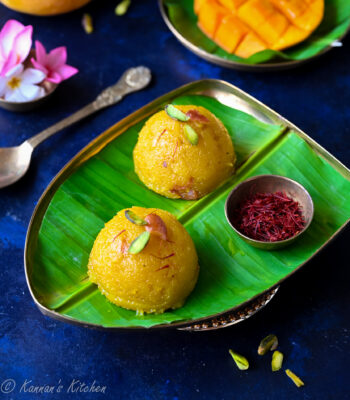
Mango Rava Kesari or Mango Sheera is an Indian dessert made using semolina or rava (sooji) and fresh mangoes.

Roasted Poha Chivda

Roasted Poha Chivda

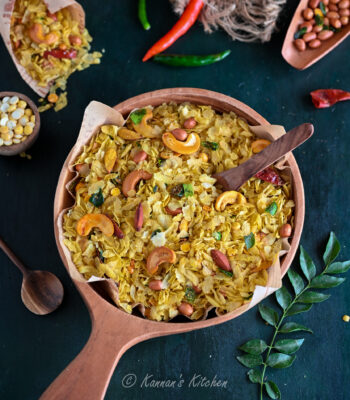
Roasted Poha Chivda is a healthy no-fry snack or namkeen made using flattened rice or poha with groundnuts, variety of nuts and spices

Andhra Style Palak Pappu

Andhra Style Palak Pappu

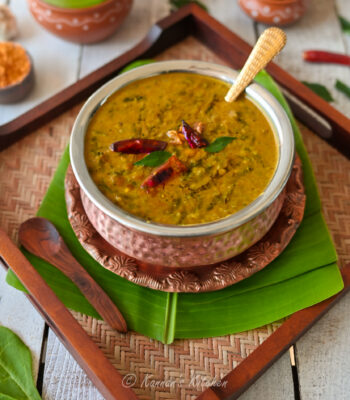
Andhra style Palak Pappu or Palakura Pappu is a native dish from the southern state of Andhra Pradesh in India, made using Toor dal, spinach, tempered with onions and garlic. This dal is a flavour bomb and characterized by its spicy, tangy and pungent flavours. It is a signature dish served in all Andhra style banana-leaf meals.

Dal holds a special place in Indian vegetarian cuisine, and relished in different forms in different parts of the country. India is perhaps the only country that uses a wide range of dal or pulses for cooking, with Toor dal being a favourite for many. This spinach dal is quite different than the Dal Palak made in North India, especially due to the unique use of ingredients like tamarind for the tanginess, onions and garlic for the pungency and green and red chillies for the spice which is characteristic of Andhra cuisine.

Although Palakura pappu is a pretty staple dish in Andhra households, but it gained it’s immense popularity from Andhra style restaurants in Karnataka, Tamil Nadu that serve this as part of the banana-leaf meals. The restaurants like Nagarjuna, Nandhana Palace in Bengaluru are especially famous for this thick and flavourful dal. I absolutely gorge on this dal whenever I visit Nagarjuna, and tastes divine when paired with spicy Dondakaya or Ivy gourd stir fry, and Beerakaya Pachadi (Ridge gourd chutney). This dish is a spice lovers dream, and would definitely make you shed some sweat from your forehead 🙂

Andhra Style Palak Pappu

Andhra food generally has two dominant flavours – spice/ heat and sour/tangy and this palakura pappu is no different. Tamarind is used liberally for sourness, and in this recipe there is a combination of tomatoes and tamarind which gives a lip-smacking tanginess. A combination of Red and Green chillies helps pack a punch of heat in this dish. Do not get intimidated with the amount of chillies that go in Andhra dishes! Once you get used to this spice level, you never look back!

What gives this dal a unique taste and flavour is also the liberal use of onions and garlic. It is not just plain use of onion and garlic, but the technique in way it is cooked which adds to the depth of taste. Onions and garlic are not just used while cooking the dal, but followed by tempering the same ingredients again. Here is the most important tip to make this dal super delicious – add a final tadka of garlic roasted in ghee along with red chillies which are just a step away from burning! Trust me this pungency elevates the dish to a different level!

If you cannot tolerate heat, you may tone down the number of chillies in this recipe. I have made use of Kashmiri red chilli powder for some extra spice and colour. You can use the regular red chilli powder as well.

Palakura Pappu

Although this recipe makes use of Palak or spinach, but you can make delicious versions of this dal by simply replacing palak with methi or fenugreek leaves, gongura leaves etc. Since gongura leaves are already sour, so you may skip tamarind and tomatoes for gongura pappu.

This dal is best enjoyed with piping hot rice, topped with dollops of ghee. Accompaniments like Pappu Podi or Gunpowder, any crispy stir fry veggie like Ivy gourd, fried Papad makes this a complete delicious meal. You can also have this dal with roti.

Andhra Palak Pappu

Andhra Style Palak Pappu

A spicy, tangy, pungent and flavourful spinach dal made in Andhra style
Cook Time 40 minutes
Course Main Course
Cuisine Andhra, South-Indian
Servings 4 people

Ingredients
  

  • ½ cup Toor Dal
  • 300 grams Spinach or Palak roughly 1 large bunch
  • 2 large Onions
  • 1 large Tomato
  • 6-7 cloves Garlic
  • 3 large Green Chillies
  • 5-6 Dry Red Chillies
  • Tamarind gooseberry sized, soaked in water
  • ½ tsp Asafoetida
  • 1 tsp Turmeric Powder
  • 3 tsp Kashmiri Red Chilli Powder
  • 2 tsp Dhaniya Powder
  • 2-3 tbsp Groundnut Oil
  • 2 tbsp Ghee
  • 2 tsp Mustard Seeds
  • 2 tsp Urad Dal
  • 2 tsp Jeera
  • ½ tsp Fenugreek or Methi Seeds
  • 2 sprigs Curry Leaves
  • Salt to taste

Instructions
 

  • In a pressure cooker, add half cup washed toor dal, 1 roughly chopped onion, 1 roughly chopped tomato, 3 large green chillies and 3 cloves of garlic, 0.5 teaspoon turmeric powder and 1.5 cups of Water
  • Pressure cook the dal for 6 to 7 whistles
  • Once the pressure is released, using a wooden masher, mash the dal thoroughly. Keep the dal aside.
  • Heat a kadai, add groundnut oil, and for first tempering add mustard seeds, urad dal, jeera and fenugreek seeds and fry till golden brown.
  • Next add asafoetida, 3 red chillies broken in half, 2 sprigs curry leaves, and 1 large onion roughly chopped. Sauté until the onions turn pink.
  • Next add 300 grams chopped palak or spinach. Saute and cook till spinach shrinks in volume
  • Now add turmeric powder, red chilli powder and dhaniya powder and cook for couple of minutes
  • Extract pulp from tamarind soaked in water. Add the pulp to spinach and cook for 3 to 4 minutes until raw smell of tamarind is gone
  • Add the cooked and mashed dal. Add salt to taste and add some water as required.
  • Bring to boil.
  • For the final tadka, in a separate pan, heat 2 tablespoons ghee. Add 3 to 4 roughly crushed garlic. Fry till golden brown, and then add 2 red chillies broken in half. Fry till chilli changes colour.
  • Add this tadka to dal. Mix well. Serve hot with rice.

Video

Notes

  • Be generous with garlic and chillies in this recipe
  • Addition of Methi seeds in the tempering adds a nice aroma and taste to dal.
  • Cooking palak separately and not including in the pressure cooker, helps retain its colour and nutrition
  • You can also make Methi Pappu by replacing palak with methi. It tastes equally delicious.
  • Do not skip the final tadka of garlic and red chillies in Ghee. The golden fried garlic and red chillies add a distinct flavour and taste to this dal.
  • This dal is usually served slightly thick.
Keyword Andhra Style, Dal, Lentils, Meals, Palak, Palak Dal, Palakura, Pappu, Paruppu, South-Indian, Spicy, Spinach
If you liked this recipe or have tried it, please share your feedback, comments and suggestions below.
Vellai Appam

Vellai Appam

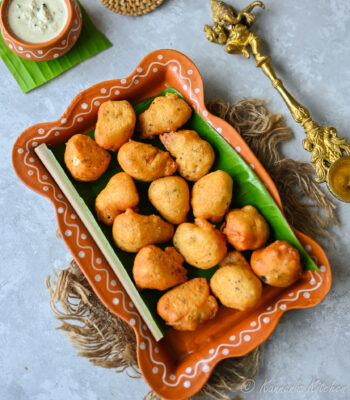
Vellai Appam is a traditional deep fried snack especially made during Deepavali in many households in Tamil Nadu. This delicacy is made using rice and urad dal and is wonderfully crisp and delicious. This is a must have breakfast dish in many places like Madurai, 

Ribbon Pakoda

Ribbon Pakoda

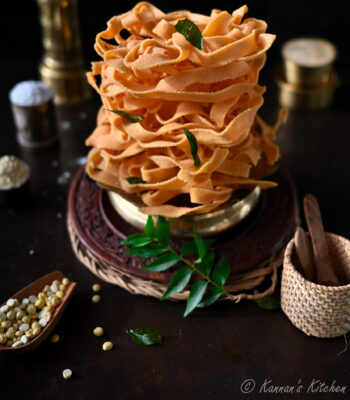
Ribbon Pakoda is a traditional South-Indian deep-fried snack made using rice flour, gram flour or besan and fried Bengal gram flour. This dish gets it’s name as it is squeezed in shape of ribbon. Traditionally this snack is made on festivals like Janmashtami and Deepavali, 

Aval Vadai | Poha Vada

Aval Vadai | Poha Vada

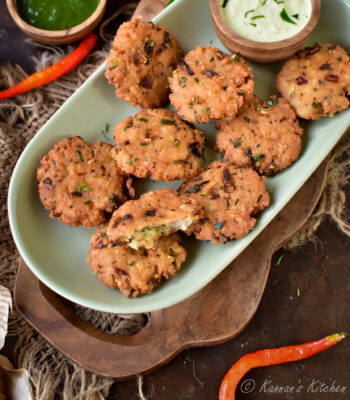
Aval Vadai or Poha Vada is an instant vada or snack made using flattened rice or poha, onions, rice flour and some basic pantry ingredients that are easily available at home. This vadai is super crisp and crunchy from outside and soft from inside.

Traditionally most of the vadas require at least 2 hours of soaking the dal, followed by grinding which can be time consuming especially if you are in a hurry. This vada does not require any soaking or grinding and can be made in a matter of minutes. So if you are looking at making vada or snack in a jiffy for a sudden rainy evening or sudden guests at home, look no further! This Instant Vada is really a winner in terms of taste, crispness and the ease with which it can be made.

While Paruppu Vadai or Channa Dal Vada is one of my favourites, especially the Masala Vada or Vazhaipoo Vada variant, but it requires the prep work as mentioned above. On certain days when you want to make Paruppu Vadai as an accompaniment for a variety rice dish like Lemon rice, Puliyogare etc., this recipe works brilliantly for such occasions as it can be made instantly.

Poha Vada | Aval Vadai

My mom used to make these vadas quite frequently, and is one of our family favourites. I am sharing my mom’s recipe in this post, however I have tweaked the ratio of couple of ingredients to make the vadai crunchier and retain the crunch for a longer duration. Unlike Paruppu Vadai, which loses it’s crispness after sometime, Aval Vadai remains crisp for several hours! Who doesn’t like a crunchy vada?! It is a boon as you can make this vadai is advance and it would still remain crunchy by the time it is served to the guests or family.

The recipe for this vadai is quite simple and demands only the basic ingredients which are regularly available in our home kitchen – Poha or Aval, Rice Flour, Gram Flour, Curd, Onions, Green Chillies, Coconut pieces, Coriander, Ginger and Curry Leaves.

We need to use the thin aval/ poha for making this vadai, however do note that it is NOT the one that is used for making chivda (which is very thin). This is the same variant of aval/ poha which you use for making the breakfast dish ‘Poha’ or ‘Aval Upma’.

Here are some of my tips to get a perfect crunchy vadai:

  • Rinse the poha with water in a colander and just let it rest for 2 to 3 minutes. Make sure there is no excess water .
  • Addition of rice flour to the vada gives a super crunch to the vada and helps retain this crispness for longer. Follow the proportion given in the below recipe for the perfect balance between crunch and softness.
  • Do not mash the poha while kneading the dough and let the poha retain it’s structure to some extent. This gives the vada a good texture just like Paruppu Vadai.
  • Always cook these vadas on medium flame so that it turns crunchy from outside and is cooked through from inside.
Aval Vadai

Serving Suggestion

Aval Vadai can be served as an evening snack, tiffin box snack, or an accompaniment for variety rice or meals. Even though it is best enjoyed when it is piping hot, but it tastes equally good even when consumed later as it remains equally crunchy.

When served as snack, this vadai pairs best with coconut chutney, green chutney or even tomato ketchup. My personal favourite is coconut chutney, as the vadai has predominantly South-Indian flavours.

Aval Vadai | Poha Vada

Aval Vadai | Poha Vada

Kannan
Aval Vadai or Poha Vada is an instant crunchy vada made using flattened rice or poha, rice flour, onions and some basic pantry ingredients
Prep Time 10 minutes
Cook Time 15 minutes
Total Time 25 minutes
Course Snack
Cuisine Indian, South-Indian
Servings 5 people

Ingredients
  

  • cups Aval or Poha (Flattened Rice) medium thin variant
  • ¼ cup Rice Flour
  • 2 tbsp Curd
  • 2 tbsp Gram Flour or Besan
  • 1 Onion roughly chopped
  • 3-4 tbsp Coconut Pieces finely chopped
  • 2 Green Chillies finely chopped
  • 1 inch Ginger grated
  • 3-4 sprig Curry Leaves finely chopped
  • 4-5 tbsp Coriander Leaves finely chopped
  • ¼ tsp Asafoetida
  • 1 tsp Red Chilli Powder
  • Salt to taste
  • Oil for deep frying

Instructions
 

  • Rinse and wash poha or aval in a colander twice or thrice. Let the poha rest in the colander for 2 to 3 minutes till it fluffs up.
  • The poha should be soft and fluffy now. You should be able to easily mash it between your fingers. Make sure that there is no excess water.
  • Transfer the soaked poha to a mixing bowl. Add all the remaining ingredients except oil.
  • Knead the ingredients by applying mild pressure to bind everything together to a dough. Try not to add water and just sprinkle few drops if required. Let the poha retain it's structure and do not make it too mushy.
  • The dough is ready when you are able to roll balls out of it.
  • To shape the vadai, with clean hands take a small portion and roll into a ball first.
  • Then flatten it between your palms
  • Continue shaping all the vadai with the remaining dough.
  • Heat oil in a kadai. Lower the flame and drop the vadai in hot oil one by one. Make sure to cook the vadai in medium heat.
  • Once the vadai changes colour, flip them and continue to cook on medium flame.
  • Drain the vadai on to a paper towel once the vadai turns golden brown.
  • Continue cooking the remaining vadai. Serve hot with chutney of your choice.

Video

Notes

  • I have used medium thin poha or aval which is used for making ‘Poha’ or ‘Aval Upma’. This requires minimal time for soaking. If you are using thick variant, soak a bit longer till it becomes soft.
  • Soak the poha in a colander, so that there is no excess water. If the poha has excess water, the dough will become mushy and sticky and not shape well.
  • Addition of rice flour makes the vadai crunchy. However do not add in excess of the ratio given above, as the vada could turn brittle and hard.
  • This vadai tastes best with onions added, however if you do not consume onion, you can replace it with cabbage.
  • Make sure to chop the onions slightly big as they tend to turn brown in this vadai.
  • Cook the vadai on a constant medium flame to get crunchy vadai.
  • This vadai stays crisp and crunchy for longer than Paruppu or Masala Vadai
  • You can also add some garlic and fennel seeds to the vada to make it like Masala Vadai.
Keyword Aval Vadai, Crunchy Snack, Instant Vada, Instant Vadai, Masala Vada, Poha, Poha Vada, South-Indian Snack, Teatime Snack, Vada
Aval Vadai | Poha Vada
If you liked this recipe or have tried it, please share your feedback, suggestion and comments below. Share this recipe with your friends and family using the ‘Share this recipe’ options below.
Elaneer Payasam

Elaneer Payasam

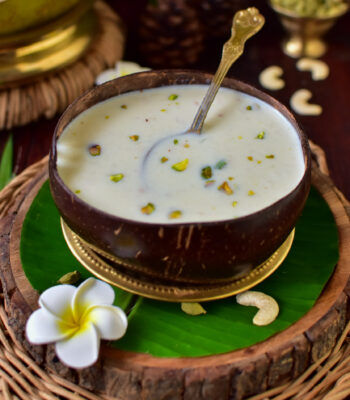
Elaneer Payasam is a South-Indian dessert made with Tender Coconut Water and Tender Coconut Flesh along with reduced milk

Aam Panna

Aam Panna

Aam Panna is a refreshing coolant drink made with raw mangoes, mint, ginger and sugar.

Karadaiyan Nombu Adai

Karadaiyan Nombu Adai

Karadiayan Nombu Adai is a set of sweet and savoury steamed rice flour dumplings offered as Neivedhyam during the Tamil Hindu festival Karadiayan Nombu. This dish however can also be had as a snack or meal on any given day and tastes delicious.

Karadiayan Nombu is a festival commonly celebrated in Tamil households on the first of the Tamil month ‘Panguni’. Women celebrate this festival for the wellbeing and longevity of their husbands as well as their marriage. This festival is almost the equivalent of the North Indian festival of Karwa Chauth which also is celebrated for similar reasons.

The timing for this festival changes every year according to the time when the Panguni month is born. Women would normally fast and break their fast during this auspicious time with this traditional offering called as Nombu Adai. Nombu adai is normally made as a pair, the sweet version which is made with jaggery known as Vella Adai, and the savoury version with tempering and coconut known as Uppu Adai. It is served with fresh White Butter.

Karadaiyan Nombu Adai

This festival celebrates the tale of Sathyavan-Savithri and signifies the way Savithri saved her husband, Sathyavan from death and Yamaraj. Savithri won this battle with Yamaraj just by her clever argument. When Yamaraj granted Savithri a wish, she asked for sons for herself, and Yamaraj eventually had to bring her husband back to life to fulfill this wish.

Karadaiyan Nombu is celebrated exactly at the time when the Tamil month of Masi ends and transitions to the new month of Panguni. Goddess Devi is worshiped on this day.

The festival is traditionally celebrated by chanting a shloka which has reference to offering of this Adai with unmelted butter to God in return for long life of the woman’s husband and their relationship, followed by tying a sacred yellow thread around the neck. For married women, the thread is tied by their respective husbands, and for young girls or unmarried women, it is tied by the elderly women in the family.

Karadaiyan Nombu Adai

In terms of the recipe for Vella Adai and Uppu Adai, it is traditionally made with homemade rice flour. This rice flour is made by soaking raw rice and then drying it on a kitchen towel followed by grinding and dry roasting. Though this is a slightly time consuming process, but worth all the effort in terms of taste and texture. You can however make this same recipe using store bought rice flour too. Dry roast the flour and proceed as per the recipe.

Vella Adai or the sweet version is made by melting jaggery in water and adding grated coconut, cardamom powder, ghee and cooked red cowpeas or Karamani. Equal amount of rice flour is added, however if you prefer your adai to be sweet, you can use extra jaggery. The dough is cooled and then flattened by hands with a hole in the center. This is then steamed for 7 to 8 minutes.

The savoury version or Uppu Adai is made by tempering mustard seeds, urad dal, asafoetida, chopped curry leaves, green chillies, grated coconut and cooking the rice flour in hot water. The dough is similarly cooled and then Adai is made and steamed for 7 to 8 minutes.

Here are a few tips for making perfect Adai:

  • While making Vella Adai, adding a small amount of ghee makes the Adai not only glossy, but also gives softness.
  • It is enough to melt the jaggery, filter and then bring to a boil again and it need not reach any string consistency stage.
  • Be careful to stir the rice flour quickly and on medium flame to avoid any lumps. You can also use a whisk.
  • For Vella Adai, I prefer to add the cooked cowpeas after the dough is incorporated, as sometimes if the cowpeas is cooked in jaggery, it tends to become hard.
  • Adding grated coconut makes the adai soft. For Vella Adai, I use a mix of both grated and chopped coconut for some crunch.
  • Grease your hands using Ghee before flattening the Adai. We prefer to flatten them slightly thin as it turns very soft this way.
  • Adai is to be steamed only for 7 to 8 minutes.
  • Wait for the adai to cool completely before you take it out of the idli plate. If you try to take it out immediately, it might break.

Serving Suggestion

Vella Adai and Uppu Adai are generally made and served in pair for Nombu, however you can make them individually too on any normal day. This adai is served with white butter and tastes good by itself. It can be a full meal in itself, or you can make this as a healthy snack.

Karadaiyan Nombu Adai

Karadaiyan Nombu Adai

Kannan
Karadaiyan Nombu Adai is a set of sweet and savoury steamed dumplings made from rice flour, cowpeas and jaggery, specially made during the Tamil festival of Karadaiyan Nombu
Prep Time 2 hours
Cook Time 35 minutes
Total Time 2 hours 35 minutes
Course Main Course
Cuisine Indian, South-Indian, Tamil Nadu Cuisine
Servings 4 people

Equipment

  • Idli Steamer

Ingredients
  

For Base Preparation

  • 2 cups Raw Rice
  • ¼ cup Red Cowpeas or Karamani or Chowli
  • Salt to taste

For Vella Adai

  • 1 cup Rice Flour homemade
  • 1 cup Jaggery preferably dark colour
  • 3 tbsp Cooked Red Cowpeas
  • 2 cups Water
  • ½ tsp Cardamom Powder
  • 1 tbsp Grated Coconut
  • 1 tbsp Finely Chopped Coconut Pieces
  • 1 tbsp Ghee
  • Little Oil for greasing Idli plates

For Uppu Adai

  • cup Rice Flour homemade
  • cup Water
  • 4 tbsp Cooked Red Cowpeas
  • 3-4 tbsp Grated Coconut
  • 2 tbsp Coconut Oil
  • 2 tsp Mustard Seeds
  • 2 tsp Urad Dal
  • Ghee or Oil for greasing
  • 2 sprig Curry Leaves finely chopped
  • 2 Green Chillies finely chopped
  • tsp Asafoetida
  • Salt to taste

Instructions
 

For preparing homemade rice flour

  • Soak 2 cups of Raw rice (Sona masuri or any dosa rice) for 1½ hours
  • Drain the water from the rice completely. Spread it on a large white cloth like dhoti or kitchen towel.
  • Let the rice air dry for around 30 minutes or till it is 90% dry.
  • Grind the rice in a mixer grinder to a fine powder.
  • Sieve this rice flour in a fine sieve.
  • Transfer the remaining coarse flour back to the grinder jar and grind again.
  • Sieve again and repeat the process as required. You should finally be left with almost no coarse rice flour.
  • 2 cups of raw rice should yield roughly 2.25 cups of Rice Flour
  • Now dry roast the rice flour in a Kadai on medium flame till is warm or just hot. Turn off the stove. The rice flour is ready.

For cooking Red Cowpeas

  • Dry roast ¼ cup of red cowpeas or Karamani in a pan on a medium flame. Roast till it is aromatic.
  • Pressure cook the cowpeas with half a cup of water and some salt. Pressure cook for 2 to 3 whistles or till it is 90% done. Do not overcook the cowpeas.
  • Drain the water from cooked cowpeas completely. Keep aside.

For Vella Adai

  • In a heavy bottom kadai, add 1 cup of jaggery and 2 cups of water and bring to a gentle boil and the jaggery gets melted. The ratio of rice to jaggery to water is 1:1:2
  • Filter the jaggery syrup to get rid of any impurities
  • Add the jaggery syrup back to clean kadai and bring to a boil again. Add ½ tsp cardamom powder, 1 tbsp Ghee, 1 tbsp grated coconut and 1 tbsp finely chopped coconut pieces. Mix well.
  • Now add the rice flour and stir continuously to avoid any lumps. You can also use a whisk if required.
  • Once the mixture comes together, turn off the stove. Transfer to a plate and cool completely.
  • Add 3 tbsp of cooked cowpeas and mix well. The dough should be firm now. Knead gently.
  • To prepare the vella adai, grease your hands well with ghee. Take a small portion of dough and roll it into a ball. Flatten it between your palm to a slightly thin disc. It should not be too thin, nor too thick. Now make a hole in the centre of the Adai.
  • Continue preparing the remaining adai.
  • Grease the idli plates and place the adai individually in each of the cavity. Steam the adai with the lid covered for 7 to 8 minutes.
  • Once the adai is cooked, take the idli plates out of the steamer and let it cool completely before taking it out. If you try to take it out while it is hot, it might break. Vella adai is ready.

For making Uppu Adai

  • In a kadai, add 2 tbsp coconut oil and once it is hot, add mustard seeds and urad dal for tempering. Add asafoetida. Mix well.
  • Next add finely chopped curry leaves and green chillies.
  • Add 2.5 cups of water and bring to a gentle boil. The ratio of rice flour to water is 1:2.
  • Add 4 tbsp of cooked red cowpeas.
  • Next add 3 to 4 tbsp of grated coconut to it.
  • Now keeping the flame medium, add 1¼ cup of prepared rice flour, and stir continuously to avoid any lumps.
  • Once the dough comes together like Upma, turn off the stove. Transfer to a plate and cool it completely. Gently knead it once.
  • For preparing the adai, grease your hands with ghee and take a small portion of dough and roll and then flatten to a disc between your palm. Make a hole in the center.
  • Continue preparing the remaining adai. Now line them in greased idli plates. Steam the adai for 7 to 8 minutes, with the lid covered.
  • Take the idli plates out of the steamer and take the adai using a spoon only when it is cooled completely.
  • Serve Vella adai and Uppu adai with white butter,

Video

Notes

  • Homemade rice flour works best for this recipe, however you can use store-bought flour too. Just dry roast it and use as per the recipe above.
  • Make sure not to overcook the red cowpeas. It should be only 80 to 90% cooked as it will be cooked further in the steaming process.
  • The jaggery need not be made to string consistency for the Vella Adai. It is enough to melt and bring to a good boil.
  • Adding 1 tbsp of Ghee to Vella Adai mixture while cooking, makes the Vella Adai soft.
  • Grated coconut adds to the softness of adai.
  • Be careful to stir continuously breaking any lumps while cooking the rice flour.
  • Both the adai dough thickens once cooled. So do not panic if the dough feels sticky intially. Once you knead the dough and use ghee for greasing your hands, it comes out perfectly.
  • Grease your hands well with ghee before making the adai. Release once after flattening to a certain extent to avoid sticking.
  • Do not steam the adai more than 7 to 8 minutes.
  • Make sure to cool the adai after steaming, before taking it out of the idli plate.
Keyword Adai, Festive Food, Homemade Rice Flour, Karadaiyan Nombu Adai, Karadayan Nombu Adai, Nombu Adai, Tambrahm, Tamil Cuisine, Traditional Recipe, Uppu Adai, Vella Adai
Karadaiyan Nombu Adai
If you liked this recipe or have tried it, please share your comments, feedback and suggestions below. Please share this recipe with your friends and family using the Share options below.

Falafel with Hummus & Tahini Sauce

Falafel with Hummus & Tahini Sauce

Falafel is a Middle-Eastern and Mediterranean crisp deep-fried fritter made using Chickpeas and fresh herbs.